
Oh yes indeed I sleep, and very well indeed! But I get asked this question so often – in the context of “how do you do all you do?” – that I finally decided to address this here on my blog! First, though, I have to admit that I offer my responses to this not because I think other folks need to “get more done,” and certainly not with the intent that you would follow what I do. But I do think some of the ideas I work with might be useful to at least know about .. so this post launches a series of posts that will explain some of the most useful “productivity” tools and habits that I use – and you can take it or leave it as you see fit!
So to begin, my “productivity” story began when I was about 10 years old. I read the book “Cheaper by the Dozen.” This book was published in 1948 (the year I turned 7). It was 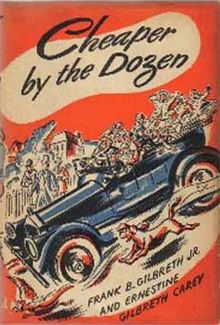 written by Frank Bunker Gilbreth, Jr. and Ernestine Gilbreth Carey, two of the 12 children in the Gilbreth family. Their parents were pioneers in studying “time and motion” to produce the greatest degree of efficiency in organizational behavior. Of course for me as a young girl, the book caught my attention because of the very interesting and often hilarious anecdotes of growing up in a family of 12 children. But what ended up having a lasting influence on me was the idea of efficiency! From the moment I read the book, I launched a personal “mission” to find the most efficient way of accomplishing any task! I determined that even if I did not become an engineer, I would always be an “efficiency expert!” This is kind of ironic since I have ended up with quite a tense relationship with “management” – but that is another story!
Watching now the evolution of my grandchildren, I am more aware than ever of the lasting influence of the ideas, skills and interests that they are drawn to in these school-age years! So if you are interested in following my next few posts that get into more details on this, remember that the “seed” of efficiency for me dates way back .. I have now have had about 65 years to refine this “skill”!
So here is my first explanation about organizing my life – that “day-timer” idea! As soon the Franklin Covey planners were published in 1997, I grabbed it up immediately — it provided a way for me to do what I had already been doing – managing my day-today schedule and the tasks I needed to do – but more efficiently! Then the application Omnifocus came along, based on the idea of “getting things done” – and I have never looked back!
I will write more about Omnifocus and other tools I use later, but the main point I want to start this series with is the importance of the calendar, and how I use it. Of course like everyone I wish there were hours in the day, but for me, one way to stretch my available time (for petting my dog, sleeping, being withe friends, traveling with Karen, being with my grandchildren, cooking fabulous meals and eating them, etc etc) is using my calendar only for the things that are actually happening in a defined time frame, and having on my calendar what I will need for that occasion so that I do not have to hunt for it. So here are the guidelines I use:
- What goes on the calendar are only those things where I have to “show up!” Tasks I need to do are in Omnifocus (with reminders, of course!). You can use any approach you prefer… even paper .. but the idea is to keep your “to-do” list OFF your calendar. For me, my calendar shows an uncluttered view of the things I have to show up for! Once I know how much “open” space there is, I can then look at the “to-do” list and figure out what is reasonable to accomplish today. If other people are looking at and helping to manage your calendar, and they might think “open” space means they can schedule things for you, DO make a calendar entry as often as you need it, indicating you will be getting your tasks done. You can call is “Writing” or “Tasks” – just let other people know they actually cannot use this time!
- Linked to my calendar events is all the information I will need for that occasion .. the address and phone number of where it is happening, the URL of any online resources I will need, a note about where I can find the minutes of the last meeting or any documents I need. If there are tickets I will need for the event, my calendar has a note reminding me of where the tickets are! If I have to take something along with me to the event, the calendar note includes what that is! This is crucial even for social events … if I need to take a main dish to the potluck, my calendar has a note about what dish I am taking.
- When I schedule a calendar event that requires advance action on my part, that task goes on the to-do list, NOT the calendar! So if I am going to need to shop for the ingredients for a putluck dish, and prepare it ahead of time, those tasks go on the to-do list with the advance due date to get them done. Example — the potluck is on Saturday. I need to shop on Friday for the particular ingredients for the dish I am preparing, and I prepare the dish on Saturday morning. But those tasks do NOT go on the calendar. Only the potluck goes on the calendar. My to-do list shows that shopping and cooking have to be done on Friday and Saturday. Since these are “tasks” that can happen at any time that works best as the time approaches, I can wiggle around to manage how and when these preparation tasks get done! And, my calendar for Friday and Saturday have “open” times when I can get them done – I know the protect this time if at all possible because I can see the potluck coming up on the calendar, and the to-do list is warning me about it. If its, turns out that the open time evaporates, then I know that I will need some help with the task (someone else will have to shop for me), or, I will need to reconsider what i am taking to the potluck!
OK .. enough for now … stay tuned .. Omnifocus will be next!
 as Praxis
 quilt, shown above as the banner for this web site, is featured! Here is an excerpt from the narrative I wrote about the quilt: “Just as the idea of health is a holistic construct, a quilt has a wholeness greater than the sum of its many parts. Its messy, unattractive underside is essential for the complex pattern to emerge, much as countless physical and psychological human processes are essential to what we recognize as health and well-being” (








 Peggy L Chinn