Reflections on why we all can’t “just get along”

The words are so easy .. “let’s just all get along.”  But the actions are so very hard.  My thoughts have turned to this human dilemma recently because I have (finally) developed a web site/blog for my book “Peace and Power.”  And then there is the very contentious, exasperating and tiring clamor that goes on in the U.S. government these days, not to mention the tensions around the world.  Some days it seems like the best thing to do is to dig a hole and just ignore all of it.  But of course, even though it seems like the larger political scene is far removed from our individual every day lives and there seems little that we can do, ignoring what is going on that larger world does nothing to change that world either.  So for me, it seems that the slogan “think globally, act locally” has a lot to offer, and so turning attention and energy to ways to create peace and harmony in our personal lives at least plants a seed of possibility in the world.

“Peace and Power” is a process for group interaction that is intended to do exactly this .. plant a seed of possibility for getting along to together in groups where everyone participates, everyone thrives, and everyone shifts to ways of dealing with conflict where everyone reaches an understanding of one another, and can be at peace with one another despite our

Cover, 4th Edition

Cover, 4th Edition

differences.  This last sentence illustrates the problem — it represents what most people want in their lives, and it sounds so wonderful and so appealing.  But at the same time most people also assume that making that ideal real is next to impossible and pretty much out of reach.  In my experience, the reason that the ideal seems so out of reach is that people have not learned how to “practice peace.”  We have learned how to “practice war” even in families where we have early lessons in relating to others.  It is just so much easier to strike out, to let anger run amuck, to manipulate in order to get the satisfaction of getting our way.

But I believe that many people, maybe even most people, have also learned the ways of peace – how to respect other people’s wishes and desires, how to negotiate conflict so that everyone wins, and how to comfort one another when things are tough.  These ways of being together take time, and energy.  Settling conflict takes time to sit together, to talk, and to reach understanding.  It is harder to take turns than to impose one’s will on others.  It is harder to exercise the discipline of self-control than to strike out in anger.

“Peace and Power”  is built on the ideals of “getting along” together  – an ideal that would well serve all people of the earth.  “Peace and Power” approaches are not a magic solution, nor are they the only ways of bringing the ideals of Peace into reality.  But these approaches do provide some ideas and guidelines for action that can shift daily practice.  I am excited about the web site and blog because it gives you the opportunity to engage in discussion around the challenges of making these changes day to day.  Visit the blog, and share your ideas!

Posted in Making change, Peace & Power, Politics, Reflections, Social Issues | Tagged , , , | 3 Comments

Lessons from puppy kindergarten

About four months ago, we adopted an adorable 2-month-old YorkiePoo who we named Jazzy.  Until about 10 years ago, I always had dogs, and have loved every one of them dearly.  Then the last of my beloved pugs, Cozie, died, and  Karen and I started traveling more, so having a dog did not seem reasonable — until now!  And what an experience it is!  As with almost everything else in life over the past 10 to 15 years, dealing with a puppy now is vastly different from what it was back then!  There actually is a considerable volume of “evidence based literature” that teaches new dog owners effective ways to train a puppy, and how to live with a dog.  And for the first time in my experience, I am living in a high-rise apartment building, so for the first time I am learning about “puppy pads” instead of a fenced yard!

So within a week of introducing Jazzy into our household, off we went to puppy kindergarten at the Berkeley Humane Society!  Jazzy excelled at recess!  She did have a few “problems” — she hated .. HATED … being restrained in any way, and used her mighty voice to let everyone know that she very much preferred to be free and playing with the other puppies.  Other puppies in the class had quirks as well,  kindergartenbut none quite as annoying as Jazzy’s insistent barking.  At first I was afraid that Nancy, the teacher, would ask us to leave.  But instead, Nancy patiently stayed focused on the experience of the class for everyone, and occasionally took the opportunity to use Jazzy to show the class certain ways of dealing with particular types of behaviors.  And Jazzy, like all of the other puppies, responded instantly to Nancy’s expert hands and voice.  Needless to say, we learned heaps in the experience, and Jazzy is a much better companion than she would be otherwise.

But there is one lesson that I learned in puppy kindergarten that had nothing to do with the “curriculum” per se.  Nancy modeled total acceptance and respect for every single dog in the group.  I kept thinking that surely she had personal preferences for certain dogs over others (I do!), and surely she must have been quite annoyed with certain behaviors (like Jazzy’s barking).  But if she had any of these kinds of preferences or annoyances, I did not feel it, and I suspect the same is true for others in the class as well.  Nancy accepted each dog for the particular canine creature it is.  She equally accepted all of us rather inept humans.  When she saw a human behavior that needed “correcting” she explained what needed to change and why, and patiently worked with us as we struggled to become effective companions for our puppies.  Nancy commented several times about the “little Yorkie” traits (that Jazzy is so expert at displaying) in a tone that was respectful and accepting of what is – not a judgmental tone one way or another.  Likewise, she explained traits of other breeds, such as German Shepherds, and the misconceptions that humans carry about certain of these breeds.  Of course Nancy would have to be a dog lover to do the work that she does as a trainer, but her demeanor went far beyond the sentiment of “dog lover” to a well informed and knowledgeable unconditional regard for every doggie creature she works with.

What an important lesson, to me, for life.  I came away from puppy kindergarten with a new appreciation of what it means to live in the world with unconditional regard for others – the most challenging of whom are fellow human beings!  It was an inspiring experience, this puppy kindergarten.  I wished that our human experiences could start, in kindergarten, with learning this vital skill for life!  But of course it is never too late, and even in my 70’s, I learned heaps about what is possible in the world – in puppy kindergarten!

Posted in Reflections, Social Issues, Uncategorized | Tagged , , , | 10 Comments

Quilts, and women, with a history!

Recently I discovered that my cousin Margaret and I have matching quilts made by our mother’s sisters, Bettie and Hilda.  These quilts were made in the 1930’s and the discovery that there are two of them prompted me to post information on my “Peggy’s Quilts” web site about the quilts and how Margaret and I each came to inherit them. Go to the web site to read the story of the quilts and see photos of them

This discovery has highlighted an important “lesson” for all women in this critical period of history when women’s rights are at the same time so threatened, and so much stronger than ever before.  Our current situation, particularly the situation surrounding reproductive rights, is grounded in a history that is approximately parallel to the “life” of the quilts that Margaret and I inherited.  Margaret Sanger established the American Birth Control League, which later became Planned Parenthood.  In 1929, probably about the time that our aunts started planning and constructing our quilts, she established the National Committee on Federal Legislation for Birth Control.  Today, we have a significant collection of documents that provide a “picture” of Sanger’s work, and the many dimensions of her beliefs and commitments that shaped her activism.  But we do not know, and will never know, the stories of the dozens of women who supported this work.

The quilts illustrate this point.  Neither of the quilts has a label – the only signifier that quilters have to document that they are the creator of the quilt.  Margaret and I both have the verbal accounts that our aunts passed on to us about the quilts but when we acquired them, we did not think to ask many questions about the quilts that now seem quite important .. the exact dates, what inspired them to make them, what was the context (were they engaged to be married, or hoping to marry?)  Was this a happy time?  What was going on in the family?  What were our mothers (their sisters) doing when these quilts were made?  Who were their friends?  What were they concerned about?  Were they aware of the struggle that was going on in terms of women’s rights to have accessible birth control?  Since they came of age shortly after women won the right to vote, did they vote, and what political values did they hold?  In short — who were these women who invested hours of time and energy into making these beautiful works of art?

These and many other question surround women’s history.  While we cannot retrieve what we do not have from the past, we can make a commitment to participate in making our own histories — histories of ideas and values that shape our lives, and the actions, large and small, that shape the world in which we live.

Posted in Art, Feminism, Reflections, Social Issues | Tagged , , , | 4 Comments

Feminism is not dead, and neither is this blog!

Well perhaps this blog has been bogged down lately, and perhaps some folks feel that feminism has taken a back seat if not bogged down or dead.  But in fact, these perceptions are far from reality!  My blog story is the easy one — I have been busy on other blogs (ANS in particular) but I have a rhythm there now and am turning back to important stories here!  But the big story revolves around feminism and women’s movements around the world

If anyone has been lured in to the popular mistaken notion that feminism is dead, the “Up with Chris Hayes” show on Saturday February 9 is an important media-document that will dispel that notion entirely.  The first segment of the show focused on the recent war on women by the political right int he U.S., and how women are addressing the issues that have been raised in this political environment.  Most of the show, however, focused on world-wide women’s movements.  The fundamental message of this discussion, for me, is that there is simply no going back. So much more needs to be accomplished, but unlike any other period in history, there are strong women worldwide engaged in significant movements and projects, large and small, that firmly situate women’s rights and women’s concerns as strong elements shaping the future.

The panel included women from the early 2nd wave of feminism in the United States, but a majority of women are involved in global feminist projects – a significant message in itself.  Here are the  eight women on the panel:

Gloria Steinem (@GloriaSteinem), author, lecturer, editor, feminist activist, co-founder of Ms.magazine. She helped launch the Women’s Action Alliance, National Women’s Political Caucus, the Ms. Foundation for Women, and Take Our Daughters to Work Day.

Marlo Thomas (@MarloThomas), actress, author, activist, and national outreach director for St. Jude’s Children Hospital.  She launched her career with “That Girl,” which ran from 1966-1971, a sitcom she co-conceived and produced.

Melissa Harris-Perry (@MHarrisPerry), professor of political science at Tulane University, host of MSNBC’s “Melissa Harris-Perry,” columnist for The Nation.

Mona Eltahawy (@monaeltahawy), columnist and public speaker on Arab and Muslim issues.

Rangina Hamidi, president of Kandahar Treasure, the first women-run business in Kandahar.

Sarita Gupta (@saritasgupta), executive director of Jobs with Justice, co-director of Caring Across Generations.

Laura Flanders (@GRITlaura), founder of GRITtv.org, contributing writer to The Nation.

Mallika Dutt (@mallikadutt), founder of Breakthrough India/Breakthrough U.S.

Clips from all of the segments are available on the MSNBC web site, but this one in particular is one I highly recommend – it is titled “What 21st Century Feminism Looks Like”:

http://www.nbcnews.com/id/46979738/ns/msnbc-up_with_chris_hayes/#50753019

Visit NBCNews.com for breaking news, world news, and news about the economy

Posted in Feminism, Politics, Social Issues | Tagged , , , , , , , , | 3 Comments

The dawn of possibility for health care – meaning HEALTH – not just medical care

I admit it .. I am quite a fan of the Affordable Care Act (ACA).  Like a host of others I would prefer, of course, a single payer plan.  But this law is a great start. If it serves to give our nation evidence that medical care costs can be contained, and even lowered, with an approach that focuses more on health promotion, disease prevention, and efficiency plus effectiveness .. then it promises to go a long way toward dispelling many myths that opponents still tout.

There are several things about the law that give me hope.  One is that it is a start toward making prevention a priority, which includes many of the kinds of services that we as nurses bring to the table in large doses!  We know how to educate people and families, and how to tune in to what concerns or worries a family about what is going on with their health, and guiding them in ways that address their concerns and find solutions that work best. Of course other providers can do these kinds of things but the fact is that given the structure of our current disease-treatment-oriented system, the kinds of concerns have been shuffled aside and not given much oxygen.  Now, there is an opportunity for people to begin to experience the difference that good prevention and health promotion can make in their lives.  There are those who decry the expense that  arise from some of the new benefits.  To those I say — wake up!  One of the reasons our country has run-away costs associated with our s0-called “health care system” is that it is a non-system that ignores the benefits of prevention and health promotion, and at the same time gives our economy an avalanche of waste.  So to oppose the ACA is to support continued high cost, poor health for our nation (especially the most vulnerable among us), and blatant inequity and disparity in the health of American citizens.

Of course the first priority at this very moment is to make sure that Obama and other ACA supporters can prevail for the next 4 years at least.  But just as important, everyone needs to be informed about this bill, what it does, and also, of course, how it needs to be improved.  Here are few hints for starters:

  1) Get a copy of the book “Health Care Reform” by Jonathan Gruber.  It is in comic-book format, easy to read and very informative about the basic elements of the ACA.  Gruber is one of the architects of the Massachusetts plan, and in turn the Affordable Care Act.  If you do not explore anything else, get this very affordable book, and then pass it along to someone else!

2) Visit the HealthCare.gov web site.  One of their recent blog posts is a guide to Health Insurance Costs and Benefits.  Be sure to check back in often over the next couple of years, because many of the benefits covered by the ACA will be kicking in over the next couple of years.

3) If you have medical insurance, find out more about how the ACA effects your own coverage, and start taking advantage of some of the benefits that you now probably can receive that you might not have received before.  Women in particular need to be informed – and take action.  Many of the prevention and disease detection benefits that are now covered by the ACA have not been available to us until now.

Share your thoughts and ideas here.  I would love to know about suggestion for how we can all make this bill work for ourselves, our families and friends.  And let us know your ideas about what needs to be improved to make this bill even better!


Posted in Health Care, Making change, Politics, Social Issues | Tagged , , , , , , , | 12 Comments

Twitter for a digital immigrant

Finally, I am a twitter nut!  Ordinarily I am the first one in line for the latest and the greatest, but twitter has simply eluded my comprehension. Twitter has made me feel like a visitor to a foreign land where certain delicacies the natives savor just seem unapproachable to me. As a print native immigrating to digital-land, the notion of  hundreds of 140 character messages streaming past my screen at lightening speed was just more than I could bear.

Then the 2012 political season began to happen, and I began to suspect that by not savoring the wonders of twitter I was missing out on something really great!  So I logged in to twitter (yes, I have had an account for several years!) and started searching for a few of the political gurus that I most admire – starting of course with Rachel Maddow.  Very quickly I found tweeters who not only gave good political tweets, but several that mixed in large doses of humor – something that makes this political season a bit more bearable!

The next evolution was turning on notifications on my iPhone for the tweeters that seemed the most interesting.  I quickly discovered which ones were sending tweets every time they ate at a good restaurant (which I quickly dropped), and those who tweeted substantive information or really fun stuff.  The result — I am totally hooked!  And I have barely  become enculturated.  I am still playing around with notifications, for example, but now I learn about almost anything important happening in the political jungle before it hits the airwaves, and get leads to any number of very interesting back-stories as well.

Of course one might reasonably ask the fundamental “why” question about all of this!  For me the answer to “why” is not that I get advance reports of stuff happening (although that is very interesting), nor is it that I get several really funny quips that make me laugh every day (although that is actually a great health benefit!!).  The main reason that getting into twitter is important to me is that I have shifted into a realm of experience that is the future.  Folks can decry all the things that will be lost from the print-only ages past, but that is part of the experience of social and cultural evolution … some things that might be, or have been valuable and important fall away, while other things emerge.

Here is my take on what we gain in this future that bears a “twitter” imprint … those 140 characters are windows to a vast world of information, knowledge and insight.  But the cultural challenges for us print natives is learning how to tune in to quickly shifting mini-messages, sift through the huge universe of twitter to find what is interesting, meaningful and important, and to realize (this is the hard part!) that we do not need to read everything.  In twitter land, if it appears on the screen once, and it is important, we need to learn to trust that it will appear again and we can wait to tweet birdsee it the second, third, even fourth time.  Then we need to learn how to judge which of the tiny URLs that appear in tweets to follow, and set up a system for following the depth later when we have time to dwell with what is there.

But there is one “danger” that is new to this digital universe — it is all too easy to create a bubble.  The “bubbles” also exist in all forms of media – TV viewers, for example, have 3 different bubbles to choose from – the liberal progressive bubble, the conservative bubble, and the pablum bubble (media outlets that superficially report events).  I admit proudly that my bubble is clearly defined in the liberal progressive realm.  And what most excited me is that I found several feminist tweeters (including Planned Parenthood, Feminist Press, Ms Magazine), a fact that reassures me that women are indeed coming into the digital realm slowly, but surely.

So knowing the limitations of my own bubble, my challenge is to remain sensitive and open to information channels of all sorts that point in the direction of a wider understanding of the world beyond that which suits my particular fancy.  This is where the humor plays a very important role!  In fact, perhaps two of the most important news sources available today are Jon Stewart’s “Daily Show” (of which Lizz Winstead is an important part) and Steven Colbert’s “Colbert Report.”

So I would love to hear from others about twitter!!  Share your comments here!

Posted in Making change, Politics, Social Issues, Technology | Tagged , , , , , , | 6 Comments

Truth, Reason and Integrity

My last post was over 3 months ago!  The truth is that I could pull any number of reasons out of the atmosphere and any explanation would suit as well as the next!  The fact is that this admission brings me to what has inspired this post over the week-end between the Republican and the Democratic conventions (which, full disclosure, I am observing part-time by way of MSNBC).  What has dominated the media – even the mainstream media – are claims of truth and lies spoken from the GOP stage, and lots of punditry around this issue and how the Democrats need to respond.

But  before I go further with the politics, a bit of background related to my perspective on “truth.”  The notion of truth has always puzzled me. Perhaps this comes from my early years in Hilo, Hawaii, growing up in a fundamentalist Christian household that proclaimed to hold “the truth” about just about any subject, situated in a  community that was predominantly Buddhist.  What came through to me as a young child from folks in in my community  outside of my family was the possibility of many truths, and the honor in seeking what is true in everything.  As I came of age and started grappling with matters of truth it was this message from my childhood community that seemed much more interesting, engaging, and authentic than the prescribed proclamations of a particular religion.  This theme remained constant for me in my early academic career, when Maeona Jacobs Kramer and I wrote our book focusing on the development of nursing knowledge.  Our thinking from the start held that scientific truth is not static — that the purpose of science is to fundamentally challenge what is thought to be true and refine the scientific evidence over and over again until, at some point, theoretical explanations of the world evolve to reveal fuller and deeper understanding, perhaps eventually establishing certain facts. Establishing political and historical “facts” requires a different, but essentially equivalent path – facts are established by reliable public accounts events, strengthened to the extent that each bit of evidence can be corroborated by other accounts of the same event.  Still, I remain always alert to the possibility that some essence of “truth” can be found even in seemingly contradictory accounts of the same thing.

So the fall-out from the GOP convention is quite fascinating to me, and I was thrilled to find Ezra Klein’s brilliant essay on the matter of truth posted on August 30.  Unlike most of what we hear and read from political pundits, Ezra reveals his very honest struggle to come to terms with what is true and what is not true in what we are hearing from the key players in the political drama before us.  He speaks of his discomfort with sweeping generalizations that many in the liberal media have used to characterize, in particular, Paul Ryan’s convention speech — nothing but lies.  So Ezra went back and took a look at the speech more than a couple of times, examining each of the claims against documented evidence.  In the middle of telling us what he found, he reveals what I think is the essence of integrity – he says:

I want to stop here and say that even the definition of “true” that we’re using is loose. “Legitimate” might be a better word. The search wasn’t for arguments that were ironclad. It was just for arguments — for claims about Obama’s record — that were based on a reasonable reading of the facts, and that weren’t missing obviously key context.

Ezra outlines what he found in his search for evidence that the Ryan speech was not a one-dimensional series of lies.  His conclusion: there is hardly anything in what either Romney or Ryan are saying that can be validated with the evidence.  This is a conclusion that leaves Ezra, and many of us, very disturbed. Yes, it is disturbing to confront this blatant abuse of public trust.  But it is also disturbing that those of us who honestly attempt to understand their viewpoints and treat their perspectives fairly come to a conclusion that must seem so one-sided and biased.   In Ezra’s words speaking of his conclusion that the Romney and Ryan messages hold little, if any veracity:

I don’t like that conclusion. It doesn’t look “fair” when you say that. We’ve been conditioned to want to give both sides relatively equal praise and blame, and the fact of the matter is, I would like to give both sides relatively equal praise and blame. I’d personally feel better if our coverage didn’t look so lopsided. But first the campaigns have to be relatively equal. So far in this campaign, you can look fair, or you can be fair, but you can’t be both.

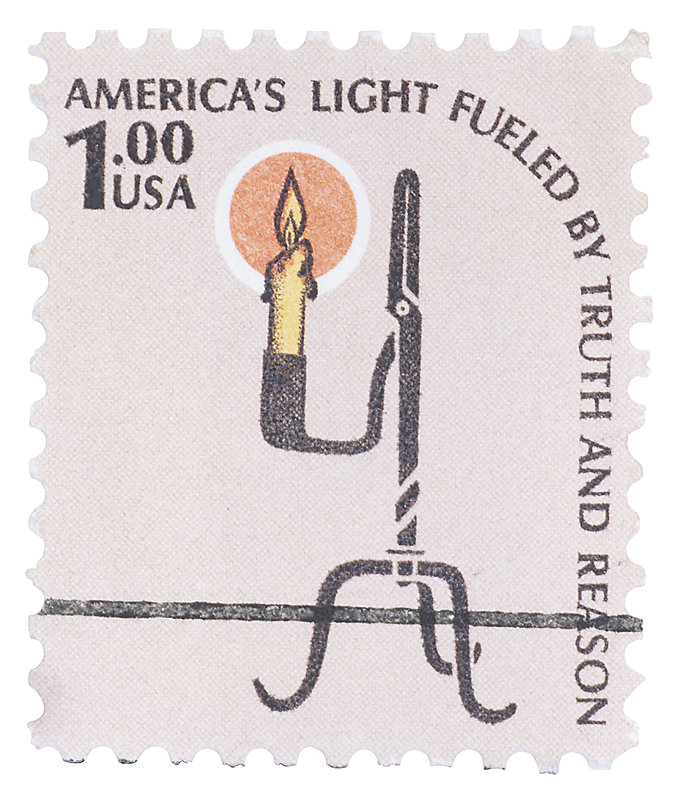
1979 Commemorative "Americana" series stampThe 1979 commemorative “Americana” postage stamp on the left says: “America’s light fueled by truth and reason.”   As Ezra’s essay points out, perhaps we are better served to seek that which is legitimate rather than what is “true” – and of course that requires a hefty dose of reason.  And to me this adds up to integrity.  Let’s call for a show of integrity.  If we do not see it, let’s challenge those speaking.  At the very least we should expect our politicians to own up to their “spin” and give us a legitimate explanation of the reasoning behind their claims.  Of course, this is complicated.  But I believe that real integrity can shine through very clearly, and this is what we need for our nation’s light at this moment in history.

Posted in Making change, Politics, Reflections, Social Issues | Tagged , , , , | 2 Comments

Hand signals – a small/huge part of changing the world!

There are several things about the Occupy movement that have intrigued me over the past several months, one of which is the practice of hand signals that has developed.  These hand signals are not totally unique to “Occupy” – some of them are familiar to folks in Quaker communities, hearing impaired communities, civil rights movements, and others.  Now, because of the world-wide use of these non-verbal signals that communicate in any language, and promote group cooperation and respect, these signals have a powerful potential to influence how “business” is conducted. Here is a video explaining the basics:

Of course part of my interest in this particular aspect of the movement is related to my long-standing commitment to create ways of working in groups that are based on principles of Peace and Power.  We have used a few hand signals in these groups, with the intention of turning away from practices of verbal interruption and out-shouting one another to gain the “chair.”  The practice of hand signals, used in a context where everyone present understands what they mean and respects what is being communicated, literally turns things around in a positive, respectful way.  We can all make this shift, in any group setting!  I believe it will start to happen!

Posted in Making change, Occupy Wall Street, Peace & Power, Social Issues | Tagged , , | 5 Comments

Lavender Health – and the matter of marriage!

Today I posted an essay on Same-Sex Marriage and Health on the new LavenderHealth blog.  I hope that many folks who follow this blog will click over to “LavenderHealth” and add your comments to the discussion of this issue!  Several months ago my colleagues Mickey Eliason, Sue Dibble, Jeanne DeJoseph and I established the web site LavenderHealth.org, and now we have added the LavenderHealth blog, and a Facebook page in order to provide for discussion and interaction around the many health issues that are central to the well-being of LGBTQ people everywhere.

We are eager to hear from you!  So visit our web site, and follow the LavenderHealth blog, and stay in touch!  I will be “back” on this blog very soon!

Posted in Health Care, LGBTQ, Making change | Tagged , | 1 Comment

“The Gays,” “The Girls,” and “The Ille(gals)”

It seems to me that it is no accident that in a season of intense backlash against forces that threaten white male privilege, political smoke screens are focusing on these three groups — LGBTQ people, women, and people of color who are entering the U.S. in larger numbers than ever. Many people I know (me included) are baffled as to why, in the face of the far more pressing issues facing the U.S. and the world today, these issues are taking a front and center We call it marriageposition on the stage. But of course, the reason is exactly in front of us … those who are keeping these issues at the center have no real solutions for the challenges that to me are actually at the center — the 3 Big E’s – Education, Economy, and Equity. And the emotionally-charged issues that focus on those who are viewed as vulnerable, are much more powerful in drawing attention away from the real “Big E” issues

The “turn” toward the fake issues “the G’s” if you will – gays, girls and ille(gals) – is not unexpected, and has been festering for decades. All of the fake issues have one thing in common … they are all symbolically enveloped by images of weakness, softness, mindlessness — easy targets for defeat, and in the process easy distractions from the real issues. But these fake issues are also, in fact, fundamentally related to the Big “E” issues. So the challenge really is that we have to call forth our finest abilities to do more than one thing at a time! First of all it is important to recognize the complex inter-connections between women’s issues, the economy, immigration, equity, LGBTQ issue and education. There are of course more issues at stake, but I use these to represent the contrasts between those that are distractions and the those that are more fundamental. If we mobilize on any one of the issues, we are, in fact, mobilizing on all of them if we recognize the connections. The connections are not going to be made in the media, nor in the dominant political discourse of campaigns. The rest of us can make these connections, and our actions are vital in the process of the unfolding situations in which we live and work.

Leslie Nicol posted a very important piece on the Nursing Editor’s blog about an author’s recent repudiation of an article he published in 2001 reporting on his study in which he interviewed people who had undergone reparative therapy. (see An Interesting Situation: Repudiation or Retraction?.) The issue at stake in the published article – gay rights and the harm of reparative therapy – is a vitally important issue. To summarize, the 2001 published research findings of the author were used by anti-gay groups to justify their defense of the use of reparative therapy to “cure” homosexuality. Recently, because of the mis-use of his work, the original author repudiated his original publication, but the editor of the journal in which it was published has not retracted the article, which in effect keeps the article in circulation to be quoted in any context and used for any purpose.

The things that drew my attention, and prompted my thoughts here, is how this illustrates the use of an issue to draw attention to a seemingly isolated issue, and the responsibility of an “actor” (in this case a journal editor) who is called upon to take a position that influences not only the scientific community, but a much larger social network that can and does appropriate information to serve its own purpose. If we look at the larger context/picture of the situation, it is possible to recognize the connections. Women, LGBTQ people, people of color are called upon at every turn to deny who we are, to change, to adapt, to “assimilate,” to become less than “other” in relation to the dominant and prevailing norms. If we recognize this connection, it is possible to form a meaningful response/action that not only addresses the issue of, in this case LGBTQ rights, and also to address the larger issue of social forces that undermine social equity, education based on social justice values, and economic priorities that protect human rights.

So here’s to the gays, the girls, and the illegals! May we prevail in keeping our issues front and center, and in the process also address the fundamental issues of education, economics, and equity!

Posted in Education, LGBTQ, Politics, Social Issues, Uncategorized | Tagged , , , | Leave a comment